56 Honors students present research, creative scholarship at annual Honors Symposium–all are now headed to the national stage to present
By William Lineberry
Honors College
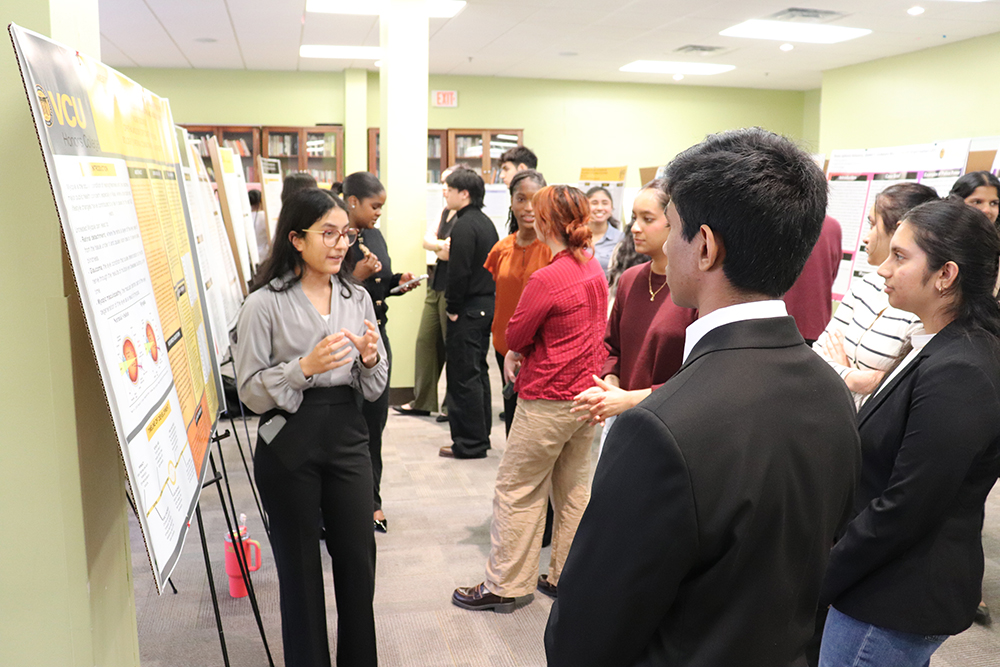 Homelessness. Personality disorders. Inflammatory skin conditions. Postpartum mental health. These and numerous other subjects were spotlighted by students recently at Virginia Commonwealth University’s second annual Honors College Research and Creative Scholarship Symposium.
The VCU Honors College held the symposium Monday, February 16 for the third year in a row. Fifty-six Honors College students presented their work to VCU faculty, staff, visiting prospective students and their families in the Honors College building.
“Participation in undergraduate research and creative scholarship provides students with a transformative experience that fosters their ability to identify and solve problems in the real world,” said Scott Breuninger, Ph.D., dean of the Honors College, which emphasizes experiential learning. “We’re thrilled to provide a venue for so many of these students to present their research and learn from one-another. We’re especially excited this year because so many of our students will also be presenting at the National Council of Undergraduate Research Conference in Richmond later this year.”
Presenting at the symposium was just the first step for some students, as all of them will now take their projects to the national stage. But they will not have to travel far to do that. NCUR 2026 will be hosted in Richmond from April 13-15 at the Convention Center with VCU serving as the host university.
NCUR spotlights students from universities in every state as well as from abroad. The Honors College students are receiving full funding to attend the conference from the VCU Office of the President and the Office of the Provost. The 2026 cohort from VCU is the largest since 2025 and about a dozen students more than each of the previous two years. Mary Boyes, Director of Honors Writing & Associate Professor, serves as the NCUR Coordinator for VCU.
The research and creative scholarship projects are a product of the Honors College curriculum, but a campuswide collaboration helps elevate the efforts. Students are paired with a faculty mentor whose expertise complements the research or creative subject, and they work together for the duration of the projects.
Sarah Golding, Associate Professor in the School of Life Sciences and Sustainability and Director of Undergraduate Research and Senior Faculty Director in the Office of the Provost, served as the Symposium’s keynote speaker.
“We want you to leave VCU as critical thinkers and help address world problems,” Golding said. Don’t ever think that research is finished once you are finished with your classes. We want you to come out of VCU as the next generation of researchers and use those skills in whatever career you go into. We’re so proud of you for getting started early and we are so proud we are able to integrate research into our curriculum here at VCU.”
Faculty members from the VCU Honors College, the Department of Political Science, the School of World Studies, the History Department, the College of Engineering, the School of Medicine, the School of Dentistry, the VCU Massey Cancer Center and College of Health Professions provided mentorship to student presenters.
The majority of the projects were conceived in the Honors Rhetoric course, where every student must choose and develop a research subject. Other projects were developed during the Honors Summer Undergraduate Research Program and through independent studies.
Abby Bressette, a senior in the Honors College majoring in Environmental Studies in the College of Humanities and Sciences, researched food sources and their scarcity for two types of songbirds in the Virginia Appalachians
“My experience with undergraduate research has been really good,” Bressette said. “I started this project my sophomore year and it’s been really cool to adapt my research question over the last two years has been huge.”
Bressette credited her mentor Lesley Bulluck, Ph.D., an associate professor in the School of Life Sciences, with working with her over the years to craft and refine her research project.
“I didn’t think I realized how much autonomy I would have at VCU to pursue my own research project,” Bressette said. “I thought I was just going to be able to help out with lab work, which I was more than happy to do, but it’s been so much more than that. It’s been a really independent project and it’s helped me decide that I want to go on and pursue a career in research.”